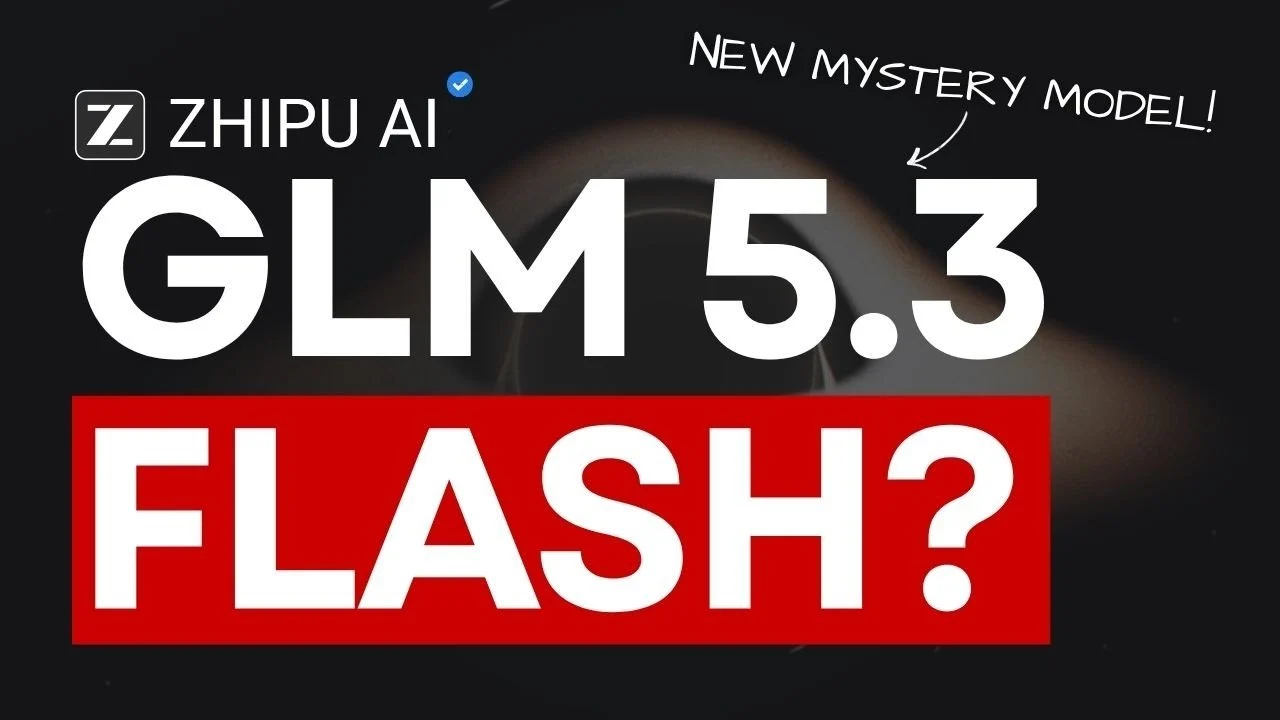
The competitive landscape of Chinese large‑language models has entered a new price‑driven phase. Zhipu AI officially released GLM‑5.3‑Flash, previously known as OX Alpha, a native multimodal model within the GLM‑5 series. This product delivers strong benchmark performance paired with aggressive pricing, directly targeting DeepSeek, which has long dominated the market for cost‑effective inference. This article analyzes GLM‑5.3‑Flash’s technical specifications, pricing strategy, Agent‑oriented design, real‑world token‑consumption simulation, domestic‑hardware‑support capabilities, and the competitive trade‑offs between GLM‑5.3‑Flash and DeepSeek V4 Flash.
Performance and Pricing Advantages of GLM‑5.3‑Flash
Despite the “Flash” naming, the model delivers far‑from‑flash‑level capabilities. On the Artificial Analysis Intelligence Index, GLM‑5.3‑Flash scores 57 points, surpassing DeepSeek V4 Pro’s 53‑point result. In public‑benchmark comparisons, its comprehensive ability reaches a level comparable to Claude‑4 Opus 4.8.
The most disruptive adjustment lies in its pricing policy. Under standard conditions, input costs sit at $0.8 per million tokens and output costs at $2.8 per million tokens. A two‑week limited‑time half‑price promotion further cuts costs: cached‑miss input drops to $0.4 per million tokens, cached‑miss output falls to $1.4 per million tokens, and cached‑hit input is reduced to $0.115 per million tokens. This promotional pricing remains valid until September 9, 2026. Its regular‑mode price is roughly one‑fourteenth of Opus‑4.8 and even undercuts DeepSeek’s discounted rates.
DeepSeek built its market position by ultra‑competitive pricing and flexible dynamic pricing that could expand margins by as high as 1100 % under heavy‑traffic pressure. GLM‑5.3‑Flash pushes inference costs down toward commodity‑service price ranges. This triggers an important industry question: will the crown for best‑value large‑model shift away from DeepSeek?
Tracing Back to OX‑Alpha, the “Cattle‑inspired” Anonymous Model
To understand GLM‑5.3‑Flash, it is necessary to review the anonymous OX‑Alpha model that appeared on the OpenRouter aggregation platform on August 20. The release came without official announcements, developer background, parameter disclosures or technical papers, earning it the reputation of a “wild‑model”. Its name OX‑Alpha drew inspiration from the popular animation Bull Demon King.
OX‑Alpha supported text, image and video inputs‑and‑outputs. The platform provided roughly 104 k token context window. Notably, developers could call the model completely free of charge, with all inference expenses covered by the operator. This zero‑cost strategy made OX‑Alpha gain explosive popularity in a short time. It quickly topped OpenRouter and OpenCode usage charts and broke OpenRouter’s single‑day model‑request record, ending DeepSeek’s 56‑day streak at the top. Even DeepSeek‑Agent’s founder publicly commented that this model seemed capable of replicating most internal baseline capabilities of their own system.
Industry observers debated whether OX‑Alpha represented an unreleased high‑capacity internal model from a top‑tier vendor. Free‑token support could not continue indefinitely given massive global‑developer traffic. GLM‑5.3‑Flash has 320 billion total parameters, yet each token activation triggers only 180 billion parameters, with an activation ratio of merely 5.6 %. Even supporting a 104 k long‑context window, the model leverages sparse‑activation architecture to concentrate computation and memory resources, lowering cumulative computational overhead for historical‑message processing. The core design goal is straightforward: deliver the performance profile of a 320‑billion‑parameter model while keeping real‑time inference costs close to far‑smaller‑scale variants.
The OX‑Alpha free‑trial phase served as large‑scale real‑world stress testing. Zhipu absorbed inference expenses to verify actual resource consumption. Practical operation data proved that the model does not incur exorbitant running costs, laying the groundwork for formal commercial‑service launch.
Optimized Architecture Tailored for Agent Workloads
The Agent scenario is where GLM‑5.3‑Flash’s structural advantages become most visible. Complex Agent workflows may invoke the model dozens or even hundreds of times within one single mission. Minor per‑request cost differences multiply dramatically under high‑frequency invocation patterns.
GLM‑5.3‑Flash is architected explicitly to treat large‑model inference as consumable high‑frequency infrastructure for Agent systems. Previously, “strong‑performance plus low‑price” was almost synonymous with DeepSeek in developer communities. Zhipu’s new release directly challenges DeepSeek’s core competitive moat: cost‑advantaged Agent inference. When building multi‑agent application stacks, developers can leverage API gateway tools such as 4sapi to route traffic dynamically among multiple model endpoints and balance cost‑performance trade‑offs.
Carefully‑chosen Release Timing
The product launch timing shows clear market awareness. On July 31, DeepSeek V4 Flash officially launched. OpenCode daily‑active usage grew by 30 %, and new‑developer registrations also increased by 30 %. On August 1, DeepSeek V4 Flash hit a single‑day processing volume of 800 billion tokens. On August 17, DeepSeek adjusted its pricing structure. The peak‑time output price of DeepSeek V4 Flash rose from $0.28 per million tokens to $1.32, representing a 4.71‑fold increase.
Sharp price hikes directly pushed some developers to explore alternative vendors. As previously mentioned by DeepSeek executives, AI‑service demand demonstrates low elasticity. After price increases, DeepSeek’s real‑world token volume dropped to less than half of its peak figure. OpenCode CEO estimated that the platform lost close to one trillion tokens of daily‑volume capacity. Right at this market inflection point, GLM‑5.3‑Flash, previously known as OX‑Alpha, arrived as a competitive alternative.
Detailed Price Comparison under Real‑world Agent Conditions
The nominal‑rate comparison is not enough to judge real‑world cost advantages. Agent‑loop workloads repeatedly feed system prompts, tool definitions, and historical dialogues. These contents can be cached and reused across rounds, so cached‑hit pricing exerts huge influence on total‑expense outcomes.
We simulate a typical Agent task: total input of 500 k tokens, with 99 % cache‑hit ratio and only 10 k fresh output tokens generated.
For GLM‑5.3‑Flash during half‑price promotion: roughly $0.146 total expense
For DeepSeek V4 Flash at off‑peak price: roughly $0.0077 total expense; peak‑time cost reaches $0.155
Within this simulation case, GLM‑5.3‑Flash promotional‑period cost is only 6 % higher than DeepSeek off‑peak pricing. However, when DeepSeek enters peak‑pricing windows, GLM‑5.3‑Flash promotional‑period pricing becomes cheaper. Once the promotion ends on September 10, GLM‑5.3‑Flash cached‑hit pricing reverts to standard rates. Under heavy‑cache‑hit Agent scenarios, DeepSeek can regain cost advantages during off‑peak hours.
In scenarios with low cache reuse, GLM‑5.3‑Flash maintains comprehensive price advantages versus DeepSeek. Therefore, developers must evaluate cache‑hit proportions of their own business scenarios before selecting models, rather than judging purely based on headline‑list‑price figures.
Domestic‑chip‑oriented Infrastructure Backing
How Zhipu maintains strong performance while compressing inference costs draws attention to its underlying computing‑resource supply. GLM‑5.3‑Flash inference runs largely on domestic silicon hardware. During OX‑Alpha public testing, single‑day processing volume once hit approximately 62 billion tokens, supported by over 100 000 domestic‑produced chips. Relevant hardware suppliers include Huawei, Moore Threads and Haiguang.
Domestic chips traditionally face bottlenecks around memory bandwidth and capacity. To support the maximum‑104 k‑token long‑context capability, Zhipu built a dedicated inference engine based on SGLang. The stack decouples multimodal encoding, prompt‑pre‑fill and token‑generation logic. It separately tunes scheduling and memory‑recycling mechanisms, optimizing throughput and memory‑internal‑storage efficiency to squeeze maximum performance out of domestic hardware. According to official statements, end‑to‑end service capability improved three‑fold compared with baseline hardware deployment, and single‑token‑processing costs have reached levels comparable to mainstream NVIDIA GPU deployments.
Third‑party semiconductor‑industry analysis institutions point out that China’s domestic‑chip ecosystem has made measurable progress. Hardware‑layer improvements plus software‑stack optimization together constitute the complete low‑cost‑delivery capability. Real‑world large‑volume traffic testing proves that this system can support massive‑scale public‑cloud‑service workloads. Independent third‑party verification is still needed to fully confirm whether single‑token‑cost metrics have truly reached NVIDIA‑GPU parity. Beyond a competitive model weight file, Zhipu brings a complete set of traffic‑validated domestic‑hardware‑inference stacks. This creates extra competitive pressure for DeepSeek.
Conclusion
GLM‑5.3‑Flash brings powerful multimodal capabilities and aggressive promotional pricing, posing substantial challenges to DeepSeek’s long‑held cost‑performance advantage. Its sparse‑activation design targets Agent‑high‑frequency‑call scenarios, and it is backed by full‑stack domestic‑chip‑optimized inference infrastructure. Nevertheless, developers must pay close attention to cache‑hit ratios and promotional‑period expiration dates. Under high‑cache‑hit off‑peak‑traffic conditions, DeepSeek still retains cost‑strength. As the promotional window expires, GLM‑5.3‑Flash’s real‑world‑competitive position will face further market validation. The price wars within Chinese large‑model inference services are far from over.
International access: https://4sapi.com
Domestic access: https://4sapi.cn
Comments
Join the discussionNo comments yet. Be the first to comment.