Jev AI Explained: The Future of Decision Models

Introduction
Developers who deploy LLMs for classification and routing tasks in production often face frustrating bottlenecks. A single request can take between 3 and 329 seconds. Output token volume may reach five times the input size. JSON parsing failures force repeated retries. When asked to quantify certainty, these models tend to reply with generic phrases such as “very confident”. This article dissects TypeSafe AI Jev, released in September 2026, and its underlying System One Models framework. After reading, readers can explain this new technical route, including its principles, ecosystem, quality constraints and business opportunities.
The opening line of TypeSafe’s official blog states a core observation: Chat models have surpassed human conversational ability, yet automation remains limited. This viewpoint comes from founder Diogo Almeida, a co-inventor of RLHF and core contributor to the training methodology behind InstructGPT and ChatGPT. According to TechCrunch reporting, Almeida left OpenAI with a clear judgement. The optimization target of existing models is human language. Natural language works well for dialogue, but it is poorly suited for software consumption. Software systems require type-safe, verifiable outputs without ambiguous uncertainty. After two years of research, TypeSafe proposed a third post-training paradigm:
RLHF (Reinforcement Learning from Human Feedback): Creates chat-oriented models
RLVR (Reinforcement Learning from Verifiable Rewards): Creates reasoning-oriented models
RLCD (Reinforcement Learning from Calibrated Decisions): Creates decision-oriented models
The official definition of Jev can be condensed into one sentence: Jev implements a frontier-intelligence function call. It accepts unstructured state input and returns typed probabilistic decisions.
The naming carries deliberate implications. System One references System 1 from Daniel Kahneman’s Thinking, Fast and Slow, representing fast, intuitive, single-step judgement. Jev is derived from economist Jevons and the Jevons paradox. As efficiency improves and unit cost falls by an order of magnitude, total consumption volume may rise sharply. The name foreshadows this scaling characteristic.
1. API Specification and Core Engineering Parameters
A Jev API request contains two primary components: state, the evaluated content which may be plain text, JSON objects or text arrays; and questions, a dictionary defining judgement tasks. Three primitive question types correspond to three output shapes.
| Primitive | Judgement Target | Return Structure |
|---|---|---|
| Choice | Select one option from N candidates, such as ticket routing group | Selected choice, full option list, probabilities and confidence score |
| Score | Rank items along an ordered scale, for example customer anger level | Numeric score, value distribution and confidence metric |
| Noul | Binary yes/no judgement, such as whether a message contains refund requests | A probability value between 0 and 1, no separate confidence field |
Key engineering parameters are defined in official documentation. Input pricing sits at $42 per billion tokens. Output traffic carries no charge. Latency ranges from 70ms to 500ms. Rate limits reach 250k tokens per second. A single request supports a 64k context window. The service only accepts plain-text input. Training focuses primarily on English, and the documentation openly admits reduced precision for CJK languages.
Three design conventions deserve equal attention alongside raw parameters.
First, one question for one judgement. Official guidance emphasizes framing tasks to match judgements a knowledgeable human can finish within one second. A broad prompt like “analyze this email and decide the best next action” belongs to System 2 reasoning. Such complex tasks should be split into atomic sub-questions, whose results are combined and weighted inside application code.
Second, all questions within one request evaluate in parallel. Adding more questions barely increases latency and consumes only marginal extra tokens. Official cookbook benchmark data shows combining 13 questions into one API call costs 11.5 times less and runs 9.6 times faster than running 13 separate requests, while preserving identical answers. This capability spawns the Speculative Fan-Out pattern. Applications prefetch all potential required judgements in one batch. Application code later selects which results to use.
Third, instruction syntax uses quoted paths to reference fields inside state. An example prompt reads: Does ticket_messages[0].text request a refund?. This syntax points the model to specific segments inside structured state, eliminating guesswork about context scope.
2. Four Foundational Design Principles
Parallel Sampling: Speed Comes From Structural Design, Not Tuning
Autoregressive models generate tokens sequentially. Each new token depends on prior outputs, forming a serial chain. Jev defines its output space at request time, bounded by N available options and M grading levels. The model runs one forward pass over the full output space and produces all probability values simultaneously. This structural difference creates a 40x to 200x speed gap. The performance gain does not stem from optimized inference frameworks. Instead, generation as a task is eliminated entirely.
Three Software Architecture Layers
TypeSafe positions Jev inside a third architectural paradigm. Traditional software implements complex decision trees built from simple primitives. LLM agents wrap model calls inside control loops, with risk of divergence at every iteration. AI-powered software embeds workflows within application code. The model appears only in narrow slots requiring programmable commonsense knowledge. Readers familiar with Guard framework will recognize this positioning. It represents an extreme version of “model-as-tool-call, loop returns to code”.
Understanding × Solution Space: A Quadrant Model for Four Technologies
Two axes define the technical landscape: comprehension ability, measuring capacity to interpret unseen natural language; and solution-space ownership, determining who defines the set of valid answers.
| Technology | Comprehension | Solution Space Ownership | Output Form |
|---|---|---|---|
| If-else | None. Language cannot enter its world | Programmer hardcodes branches | Branch jump |
| Traditional Classifier (Spam Filter) | Limited comprehension | Baked into training data; options fixed during training | Probabilities for fixed labels |
| Jev | Large-model encoder-level reading capability | Defined by users at request time; options arrive with each HTTP request | Probability distribution over user-defined candidates |
| LLM | Maximum comprehension | Model self-determined; token combinations can construct arbitrary content | Free text sequence |
Jev can be summarized in one sentence: large-model comprehension paired with user-controlled solution space. Jev projects the state material and every candidate option into a shared semantic space. Options with higher semantic similarity receive higher scores. This operation performs projection inside the user’s custom solution space.
This single principle explains every core trait.
Why it runs 100 times faster: the solution space only includes a small set of candidates. Output contains merely numeric probability values. No serial token sequence is generated, shrinking serial steps from 312 to 1.
Why billing excludes output cost: outputs are numeric probability values rather than token streams, with no chargeable generation step.
Why type errors vanish: results are physically constrained to user-provided candidates. No pathway exists to produce malformed formats.
Why confidence metrics are computable: probability distribution lives directly over candidate options. Multi-peak distributions reveal uncertainty without separate prompting for confidence.
Why conventional classifiers fail when option sets change: their solution space is locked during training. New options cannot map to the embedding space learned at training time. Each new business scenario demands retraining. Jev’s general projection capability works for arbitrary candidate lists supplied at request time.
Jev occupies a previously empty quadrant: strong comprehension plus user-managed solution space. Before Jev, if-else rules and conventional classifiers occupied low-comprehension zones. LLMs sit in the quadrant with strong comprehension and model-controlled open-ended solution space. Jev is not simply a smarter classifier. It is the first model to occupy this new quadrant.
3. Latency Breakdown: Saved Generation Steps, Not Saved Comprehension
The phrase “one forward pass” may mislead readers into thinking Jev skips content understanding. Benchmark data reproduced on M4 Max hardware clarifies the accounting.
| Model Mode | Serial Steps | Wall Time |
|---|---|---|
| Autoregressive LLM generating 312-token JSON | 312 forward passes | 19000ms |
| Jev workflow: encode state + score 28 candidates | One forward pass (52ms prefill +18ms scoring) | 70ms |
Both systems read identical source material and perform equal encoding work. The prefill step requiring 52ms cannot be avoided. Only the text-generation phase is removed. Jev’s latency budget consists of two additive parts: time spent encoding the state, scaling linearly with input length, plus scoring time for candidate options. Input length remains controllable. This trait makes Jev suitable for per-frame judgement inside real-time agent systems.
A clear distinction separates Jev from LLaDA. LLaDA parallelizes generation through masked filling. Tokens are produced concurrently, but it still builds complete sentences. Jev removes generation entirely. It only computes similarity scores against pre-defined candidates. One implements inference acceleration; the other rewrites the task paradigm. Even if Jev uses masked diffusion during training, diffusion is merely a training artifact. At runtime, scoring completes in one forward pass, with no iterative denoising steps.
4. Production Integration and Multi-Model Pipeline Considerations
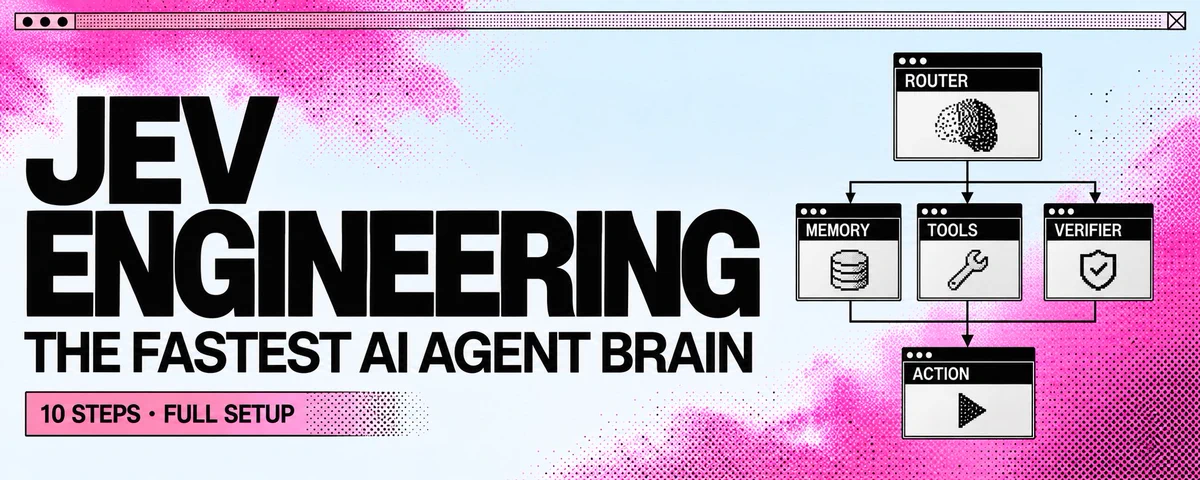
Jev fits naturally as a routing and judgement layer in multi-agent systems. It handles atomic classification, priority scoring and gate filtering, while heavier LLMs execute complex reasoning and content generation. This separation of duties reduces average token consumption and lowers end-to-end latency.
When building pipelines combining Jev and multiple large-model endpoints, developers manage distinct authentication keys, endpoints and traffic rules. An API gateway centralizes credential management and routing. 4sapi serves as unified API gateway to orchestrate heterogeneous model services, simplifying integration of lightweight decision modules and general-purpose LLMs within a single workflow.
Teams adopting Jev must account for its constraints. CJK language precision degradation is an important limitation. For Chinese, Japanese or Korean business workflows, validation tests should run on domain-specific datasets before full rollout. Task decomposition is mandatory. Complex multi-step reasoning cannot be handed directly to Jev. Such jobs must be split into atomic judgements whose outputs are aggregated inside application logic.
Conclusion
Jev opens a new quadrant for AI workloads by decoupling powerful language comprehension from open-ended text generation. It delivers typed probabilistic judgements over user-defined candidate sets. Benchmark results confirm major latency and cost advantages for classification, routing and screening tasks. It eliminates autoregressive generation and the associated token billing, while retaining encoder-level semantic understanding of unstructured input.
Its design introduces new patterns such as Speculative Fan-Out, parallel question evaluation and path-based state referencing. However, it is not a replacement for general-purpose LLMs. Complex multi-turn reasoning, creative writing and tasks requiring natural language output remain outside its scope. It excels as a specialized decision primitive embedded inside larger AI-powered software systems.
When combining Jev with other model services in production environments, unified API management reduces operational overhead. 4sapi streamlines authentication, traffic routing and endpoint governance for mixed multi-model pipelines.
International access: https://4sapi.com Domestic access: https://4sapi.cn
(Word count: 2864)